.jpg?ts=1739963716 "Lederfibel")
SMALL LEATHER BROOCH
The origin of clothing
The beginning
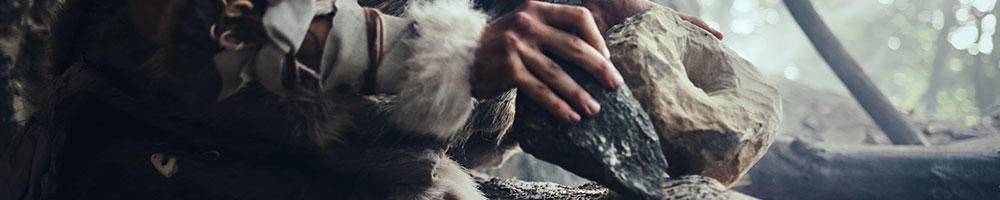
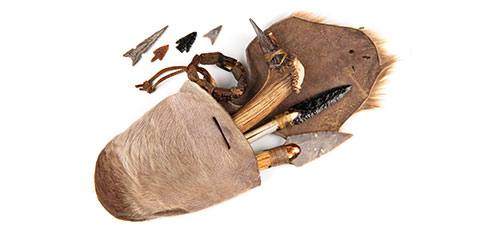
Leather has been with us since the beginning of mankind. Humans discovered the benefits of hides and skins from animals captured for food early on. From the original waste product, he produced blankets, clothing, shoes, boots, but also tent walls, straps, belts and other useful everyday items to protect against cold, wind and moisture. Thanks to the knowledge and ability to process leather and hides, people were able to survive even in the coldest regions of our planet and defy the elements of nature - Leather was the beginning of clothing.
What is Leather?
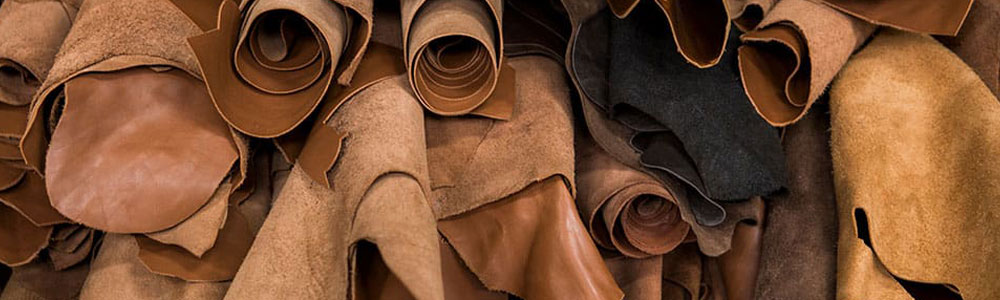
Leather is a natural product that is extremely hard-wearing. Leather has an extremely large inner surface area in relation to its weight (300 m² inner surface area equals approx. one gram of weight) due to the very fine fibres that are interwoven with each other. This gives it a high resistance to tearing, stretching and bending, as well as a high resistance to ageing and temperature. Leather can absorb up to 30% water without getting really "wet", and its other capabilities include natural moisture exchange from the inside to the outside and good thermal insulation.
The skin
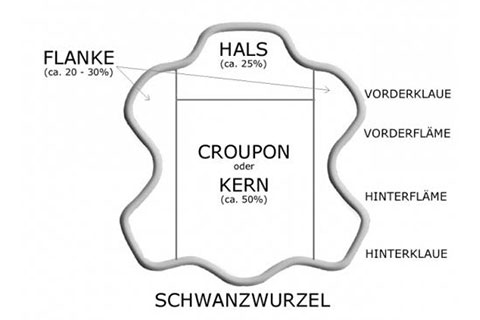
The skin consists of a network of very fine, interconnected fibres. These fibres are not connected in the same way in all parts of the body. The structure is denser and tighter in the back area and looser and with larger gaps in the belly area. The most valuable part of the hide is the back, which is mainly used for high-quality leather products. Due to the stretching of the hide when eating and drinking, the belly area of the hide is more stretched and therefore not as evenly structured as the back area. The flank area is usually more uneven (e.g. scars etc.) as the animal stands or lies with its legs in bushes or hedges.
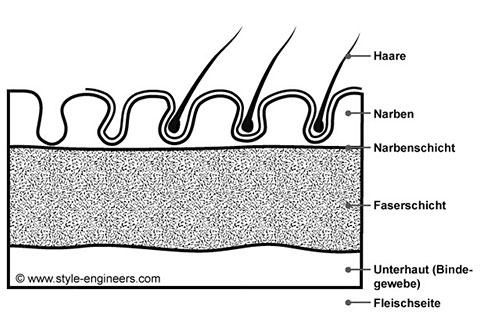
The skin of mammals consists of 98 per cent protein, as well as fat, water and minerals. It is divided into three layers: Epidermis (approx. 1% of thickness), dermis (approx. 85%) and hypodermis (approx. 15%). The epidermis is the relevant layer for leather production and consists of a dry horny layer and an underlying mucous membrane from which the horny layer is constantly renewed. The thickness of the epidermis is only one per cent of the total thickness of the skin. The epidermis is chemically removed in the tannery during liming, and the layer of interest for leather production is the dermis, which consists of a dense interweaving of tissue fibres and contains blood vessels, hair follicles and nerve endings. The hypodermis is worthless for leather production as it consists mainly of fatty tissue and veins. It is removed by fleshing before tanning and no two hides are the same. The skin of different mammals and breeds is different. The skin also varies according to age, sex, diet and weather conditions. In addition, the skin is sometimes significantly different within its surface area. The tanner must take all of this into account when selecting the raw material and during the manufacturing process in order to deliver good quality leather.
"Garment leather is a "waste product" from the food industry - no animal is slaughtered for its hide."
From Skin to Leather
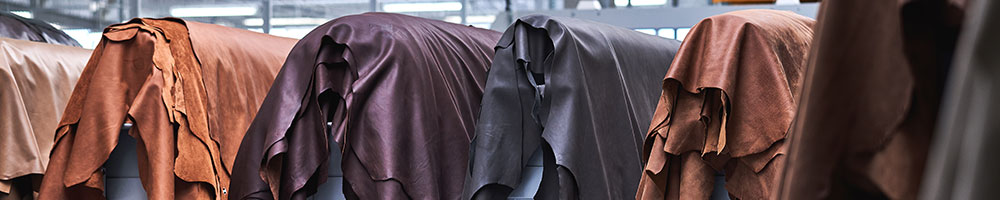
Leather production is a multifaceted and complicated finishing process. There are around 40 processing stages that a hide or skin has to go through before the biological raw material becomes the natural product Leather. Leather production begins with the preparation of the hide for tanning. The first step is a so-called cleaning stage of the soiled animal skins, which are usually preserved with common salt. This is followed by the removal of all parts of the hides that cannot be converted into Leather.
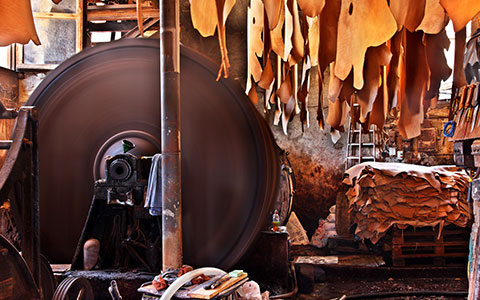
Among other things, the hides are freed from all hair and subcutaneous connective tissue and the non-collagenous proteins and fatty substances are removed in various treatment baths. All these treatment baths are carried out in huge rotating vats. Depending on the thickness and type of hide, the hide is also split into the "grain split" on the hair side for smooth leathers and the "flesh split" on the body side for rough suede leathers. At the end of these complex processes, the pure hide is ready for tanning, the so-called pelt.
Chemically, the pelt consists solely of the main component of a hide that can be converted into Leather, collagen, and is now ready for the next step - tanning.
The tanning process
Depending on the desired and required leather quality, the appropriate tanning agents are then added during the subsequent actual tanning process. The result is that the hide is transformed into Leather and, unlike the original hide, is now resistant to rotting and heat stress and can be stored and transported.
The type of tanning method used determines the subsequent use of the leather, e.g. as leather for Shoes, furniture, leather clothing or even for the automotive industry. While only vegetable-based tanning with extracts of e.g. chestnut or oak is used for abrasion-resistant shoe soles, mineral chrome tanning is the preferred tanning method for upholstery, upper or fine leathers. However, more and more chrome-free tanned leathers are also being offered.
The subsequent wet finishing processes determine the final character of the Leather. This is done with the aid of vegetable, synthetic or mineral retanning agents. As a result, the leathers have a better and more even fullness and undergo further technical quality improvements.
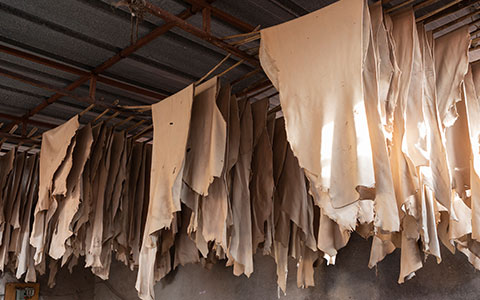
How does the Leather get its final look?
The fibres are then dyed, greased for suppleness and the fibre structure is mechanically loosened. This determines the desired properties such as elasticity or softness. The final production process is called dry finishing. This is a collective term for a series of mechanical and chemical treatments of the leather surface.
This serves in particular to finalise the visual and fashion characteristics of the Leather. However, important quality factors such as light and colour resistance can also be significantly improved during the finishing process.
In the final step, the different types of leather are given their final appearance.
Various patterns or attractive surfaces are created on the Leather by printing or embossing. In short: the finishing process gives the Leather "its final face and the finishing touches" - as the tanner says.
The most important stages of leather production

Storage and sorting
The raw goods are stored in refrigerated rooms.

Switches
Soaking removes dirt and preservative salt from the raw product and restores its original water content.
Cauterising
In the liming step, the hair is removed from the rawhide, its fat content reduced and thus prepared for tanning. This process significantly determines the properties of the subsequent Leather.

Fleshing and splitting
During the fleshing process, tissue, flesh and fat residues are removed with sharp knife rollers. The Leather is split to obtain a uniformly thick grain leather of a certain thickness. The resulting split leather can be further processed into suede, among other things.

Pickling, pickling, tanning
During pickling and pickling, the hide is prepared for tanning with acid and salt. During the tanning process, the hide fibres absorb the tanning agents. This turns the raw hide into Leather.

Withering
The wet Leather is dewatered by withering.

Sort
Leather is sorted according to various quality criteria.

Folding
The grain leather is brought to a uniform thickness. Unevenness is removed on the reverse side. The Leather is then assembled into dye lots.

Neutralising, filling, colouring and greasing
The acid from the tanning process is first neutralised. Depending on the type of leather, this is followed by filling and colouring with water-soluble dyes. Finally, fats are added to achieve the softness and elasticity required for the finished leather.

Drying
Two methods are used to dry the leather: vacuum drying, in which the moisture is extracted, and hanging drying, in which the leather is passed through drying ovens.

Softening
Softening by moving the fibres against each other is carried out with varying intensity depending on the type of leather. Particularly soft types of leather are processed more intensively than compact types of leather. Accordingly, the terms used for this work vary. A distinction is made here between STOLLEN, SCHICHTEN and MILLEN & WALKEN.

Dressing
Here, the Leather is given its final appearance in a final surface treatment. Through priming, colour application, finishing, pressing and ironing, the Leather is given a glossy or matt, single or multi-coloured, smooth or grained surface, depending on the customer's and consumer's wishes. The art of finishing consists of applying wafer-thin layers to the Leather without compromising its Optics and valued properties such as suppleness and breathability.
Tanning methods
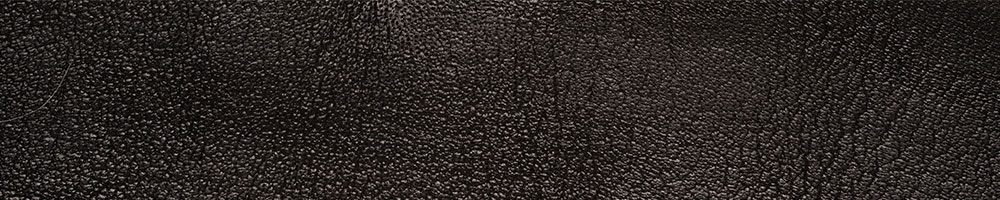
The description "aniline-tanned Leather" appears again and again, but it is tanned with tanning agents. "Aniline" is not a tanning agent. There are "aniline dyes" and "aniline leather". The "aniline dye" is used to colour Leather. An "aniline leather" is a smooth leather with open pores, regardless of whether it has been dyed through with aniline dye or not. Therefore, there are "aniline-dyed" aniline leathers and aniline leathers that are not dyed through with aniline dye.
Unfortunately, this terminology is difficult to understand and therefore often leads to confusion.
Chrome tanning
For centuries, vegetable tanning and other tanning agents dominated the tanning process. In 1858, the German technologist F. Knapp and the Swede Cavalin were the first to deal with the subject of chrome salts and tanning. The process was then patented in America by the chemist Augustus Schultz. In the following decades, chrome tanning became the dominant tanning method, with the economic time advantage of a few days compared to several months for vegetable tanning being a decisive factor. Compared to vegetable-tanned Leather, it has twice the tensile strength, but it is lighter because the chrome salts used for tanning do not fill the hide.
Vegetable tanned Leather
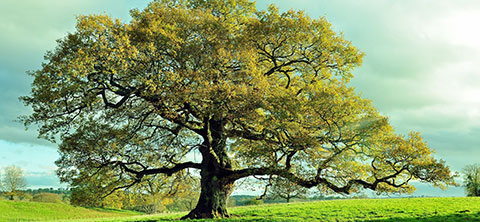
Tanning with vegetable substances has been around for more than 5,000 years and was the main tanning method for many centuries. We know from decorations on a sarcophagus that vegetable tanning was known in Egypt in the fourth millennium B.C. Thanks to the discovery of Ötzi in the ice of the Alps, we know that around 5,000 years ago different types of leather were produced for different purposes. It is assumed that today only 10 - 12% of all Leather is vegetable tanned.
Synthetic tanning
Synthetic tanning is often used as an alternative to chrome tanning. Synthetic tanning agents (aromatic syntans) are those that are produced artificially by humans and therefore have no equivalent in nature (carbon and hydrogen atoms).
The disadvantage of chrome-free synthetically tanned leathers is their sensitivity to moisture in the leather and to heat.
Chamois tanning
Manufacturer of chamois tanned Leather has been known since around 6000 BC. Chamois leather is leather tanned by oxidising tran (also known as "fish oil") in sheepskins or lambskins whose grain has been split off or shed. Leather from deer, goats and cattle is also tanned in this way, usually using cod tran.
In Germany, the term "chamois leather" covers tan-tanned suede made from sheep, lamb, deer, chamois, goat, kid and reindeer skins as well as from cow splits. France and the USA restrict the term chamois leather (called chamois there) to the flesh split of sheepskins that are only tanned with tan.
Olive leather
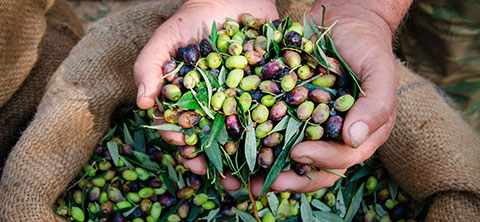
"Olive leather" and "Wet-Green" are protected Brands. The tanning process is patented and is protected by the "Wet-Green" Brands. It is also offered under the name "O'leaf tan". Olive leather is leather that is vegetable tanned with tanning agents from olive leaves. Extracts with a tanning effect are obtained from olive leaves by extraction and vaporisation. The tanning agent is in liquid form. Olive leather is generally free of chrome, but is retanned using vegetable and/or synthetic tanning agents.
Nappa & smooth leather
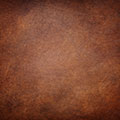
Smooth leather includes all types of leather with the grain side facing outwards. This means that the upper side of the animal skin is used. Particularly soft, chrome-tanned smooth leather is known as nappa leather. Smooth leather can be surface-dyed or dyed through (aniline leather). Leather has different properties depending on the thickness of the surface colouring. Aniline leather is much more pleasant to the touch than finished leather, but at the same time aniline leather is much more sensitive to sunlight and dirt.
Suede & nubuck leather (suede)
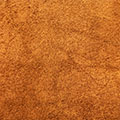
Suede leather describes all types of leather whose surface is roughened by sanding. This gives the leather a velvety character and provides a nice feel. This also includes nubuck leather sanded on the grain side and suede leather from the underside of the animal hide. A distinction is made between split suede and genuine suede (genuine suede still has the grain side and has been sanded on the flesh side - i.e. the grain side is worked inwards). Suede is often incorrectly referred to as "suede" in colloquial language.
Split leather
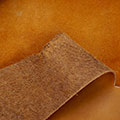
During the Manufacturer of the end product Leather, the thickness of the leather is reduced by splitting. Leather made from the lower layer of a split hide is called split leather. This Leather is characterised by two identical sides. The surface can be roughened, napped or embossed as required. Split leather is the most favourable variant of the original hide.
Lambskin (grown)
This is a special type of fur velour in which the naturally grown fur forms the inner side, while the outer velour side is coated and smooth. Both hair sheep with a short woollen coat and wool sheep with a larger proportion of downy hair are used for lambskin.
A small selection of qualities
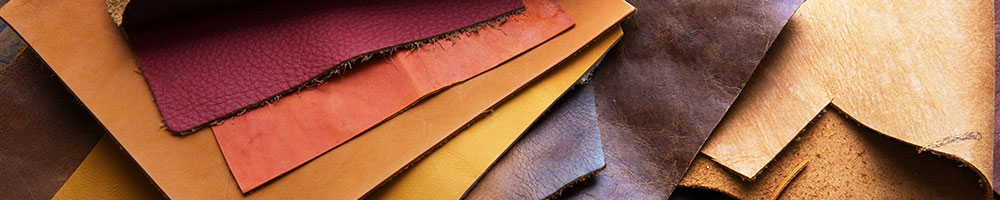
Suede is the collective term for Leather from animals that live in the wild, e.g. deer, reindeer, kangaroos, antelopes, gazelles, elk, buffalo, chamois, etc. Nowadays, however, these animals are usually no longer wild, but are kept in enclosures. "Wild leathers" are not so common because they are not slaughtered in the same numbers as cattle, goats, sheep and pigs. These animals are referred to as tame animals.
Beef & veal
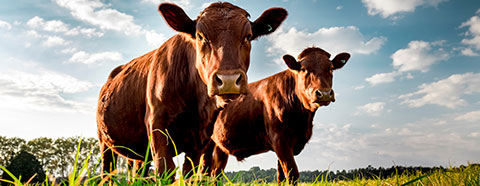
Cowhide is extremely robust, tear-resistant and hard-wearing and is increasingly used for coarse and comparatively heavy leather clothing due to these properties - for example for motorbike jackets and protective clothing in general. Calfskin is traditionally obtained from very young cattle (calves). This Leather is characterised by a particularly pleasant fineness and feel.
Lamb & Sheep
Sheepskin is similar in structure to goatskin, but is less valuable as it is usually produced from sheep breeds bred for wool production. There are countless sheep breeds with considerable differences in skin quality. sheep leather is also called "mouton leather".
Lamb is the name given to the young animal of the sheep. Lamb leather is very supple and soft to the touch. Leather is usually processed as aniline leather.
Goat
In contrast to other types of leather, goatskin has no fat deposits and is therefore more robust, but still supple and light. It is therefore more valuable than sheep leather and lighter than many other types of leather. Goat leather is often vegetable or combination tanned and is comparatively inexpensive to produce.
Buffalo
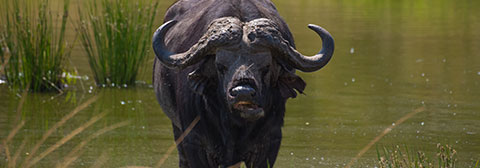
Buffalo leather and water buffalo leather are usually offered as aniline leather. They are coarse-pored leathers due to the structure of the buffalo hide. Compared to normal cowhide leathers, the significantly coarser porosity is noticeable. The fibre structure itself is also coarser. Buffalo leather has thicker individual fibres, but is not as tightly woven. Nevertheless, it is a stable and robust Leather.
Pig
Pigskin is very often used, especially in the cheaper segment of leather clothing, mostly as suede, but occasionally also as pigmented smooth leather. Pigskin is cheaper for the clothing manufacturer than lambskin. Compared to the higher quality lambskin and goatskin, pigskin is less tear-resistant and generally feels stickier than soft lambskin or goatskin suede. Leather is often labelled as porc in clothing. Velour is then referred to as porc suede.
Deer
Deerskin originally comes from Hunting and is therefore a particularly exquisite leather. As it is very soft and known for its pleasant feel, it is often used for the Manufacturer of leather trousers and smooth leather jackets. Today, this Leather comes mainly from farmed animals.
Moose
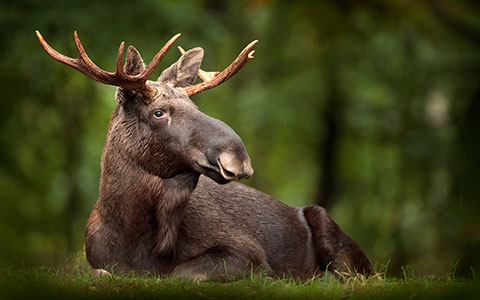
Each piece tells a story. You can "read" the structure of the Leather like in a book. Pressure marks bear witness to bites and fights for food and territory; small scars remain from insect bites. And the tiny "holes", which look like fine pinpricks, are the natural pores of particularly strong fur hairs. After tanning, the elk leather is elaborately dyed all the way through - and not covered by over-spraying with Colour. This deliberately preserves the natural colour nuances, scars and punctures - as protected characteristics of unspoilt nature.
Reindeer
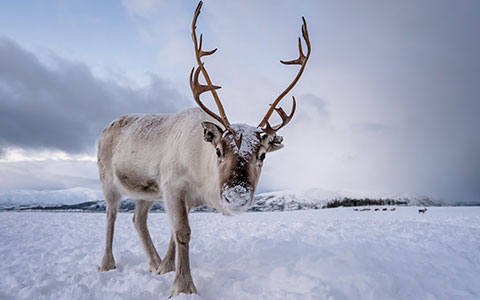
Reindeer belong to the deer family and are often kept as pets in large herds in the far north (Alaska, northern Norway, Lapland, Finland, North America and Svalbard). In Canada, the wild species is known as cariboo. The hides of these animals are usually tanned with chamois.
Wild buck
Buckskin - this is the more traditional name for the Leather of the wild goat. This fine material already has a long tradition when it comes to Bavarian traditional costume. Cleverly positioned in the golden mean, buckskin is of a nobler nature than cowhide and yet more affordable than deerskin. In the chamois-tanned version, buckskin is even a cheaper (but by no means "cheap") alternative to deerskin. One advantage is the slightly lighter weight of the leather
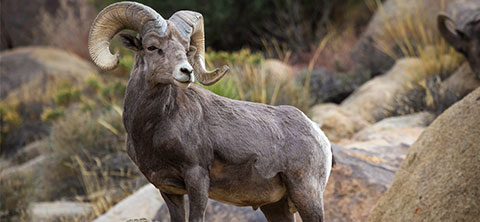
Peccary
Due to living in the wild, the Leather of the Peccary often shows scars and other defects, which are considered a sign of authenticity. Peccaries are Amazonian wild boars. They are medium-sized mammals that belong to the pig family. These animals are 90 to 130 centimetres long and usually weigh between 20 and 40 kilograms. Peccaries are found in Central and South America as well as in the south-west of North America.
Peccary leather is mainly used for high-quality Gloves due to its suppleness.
The right care
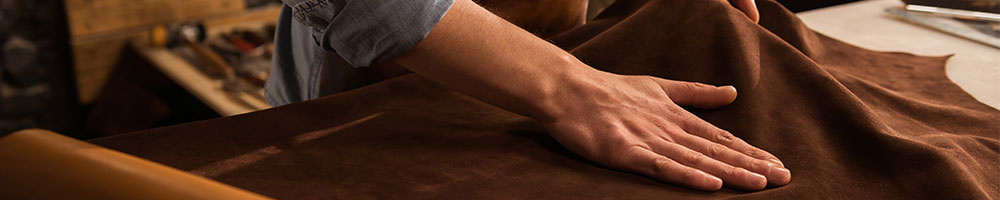
On the following pages, we would like to give you a few basic rules for handling high-quality leather clothing. If you follow these, there is not much you can do wrong when cleaning and caring for leather clothing. The most common mistakes are made during cleaning. However, choosing the wrong products also often leads to undesirable results.
The following therefore applies: ALWAYS determine the type of leather first and carefully test all cleaning or care attempts in the non-visible area (inside) and only then apply to large areas!
The most common mistakes can be made when cleaning or caring for open-pored aniline leather (through-dyed leather) or suede. Here you should proceed very carefully. Water is often enough to enlarge the stain or make it more pronounced. The following therefore applies: always test first to see whether liquids are soaking in and causing larger dark spots (stains).
Surface-coloured smooth leather (leather that has not been dyed through) can be treated with conventional leather cleaners and leather care products without any problems. But the same applies here: always work carefully! Stains are often attempted to be removed with a damp cloth or leather cleaner, but if the stain treatment is carried out too long or too intensively, the leather colour layer may be damaged. The use of products containing solvents should be avoided if possible, as these attack the leather colour layer more quickly and therefore generally increase the "damage".
If stains caused by liquids on open-pored leathers are still fresh or have only just appeared, it is advisable to carefully absorb the stains that have not yet dried with a cotton cloth (do not rub them in) and remove the residual moisture from the leather by dabbing carefully. This will prevent or reduce edge formation. Do not rub vigorously, as this can damage the surface. We recommend that you do not attempt to use special stain removers or other household remedies. Therefore, you should always consult a "leather expert" in such cases.
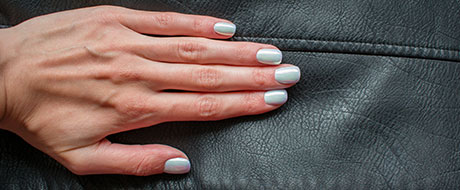
Our advice:
Test first (on a concealed area) - then start on the actual stain. Recommendation: If necessary, reproduce the "damage" on the inside and try cleaning or care there first. It is generally advisable to consult a specialist if the stain is severe (the German Leather Industry Association recommends LCK Leather Care). High-quality open-pored leather qualities in particular are much more sensitive to friction and liquids. Leather is the oldest piece of clothing and develops a natural and characteristic patina over time.
A few basic rules
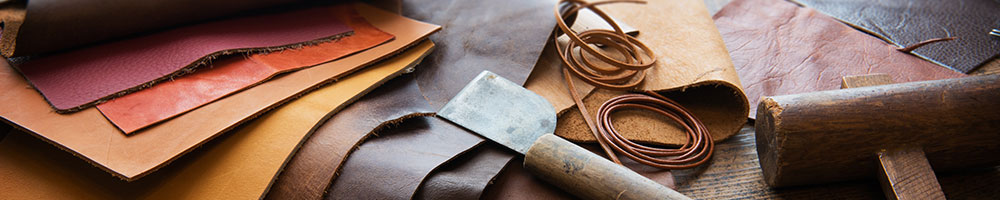
- Important! Always check whether the Leather absorbs moisture or not. With absorbent leathers (aniline leather or suede), the water penetrates and darkens the leather when rubbed. With non-absorbent leathers (surface-coloured smooth leather), the water drips off. Leather that absorbs moisture is more sensitive.
- Always test carefully in a concealed area first (inside, collar). There is a risk of the stain getting worse, especially with high-quality aniline-dyed leathers or suede.
- Leather should be impregnated regularly. Despite impregnation, aniline leather or suede parts in particular are never really waterproof and should not be worn in the rain.
- Dry wet Leather slowly and gently at room temperature. Avoid direct heating or drying in the sun at all costs. This can result in the Leather shrinking or drying out considerably. After drying, it is recommended that the leather is softly rolled with your hands.
- Garment leather can be washed using suitable leather detergents - please follow the care instructions on the garment and use the correct detergent.
- Always brush out superficial soiling carefully before washing!
- Never attempt to remove stains that have already been absorbed by rubbing vigorously. This can damage the leather surface.
- Avoid removing stains with strong solvents (acetone, nail varnish remover, turpentine, etc.) or abrasive cleaners. This usually leads to an increase in the damage.
- Treatment with unsuitable products such as shoe polish, cosmetic cream, floor polish etc. should also be avoided.
- Your garment will show natural signs of wear over time. This is normal and is part of the patina of Leather and emphasises the natural look of your garment.
- Always store leather clothing in an airy and open place. If you don't wear your garment for a longer period of time, we recommend a garment bag made of cotton or linen - Leather needs to "breathe".